

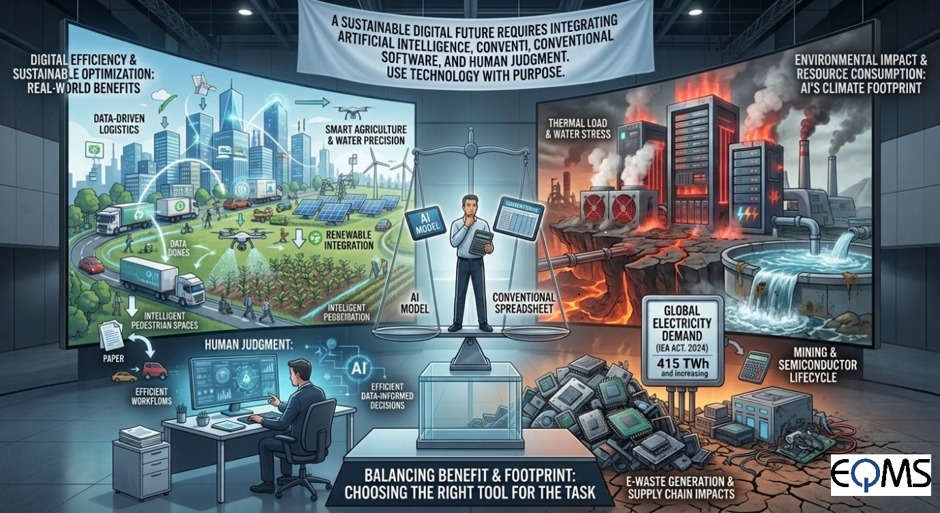
Artificial Intelligence is rapidly becoming part of our everyday lives. From writing emails and generating code to analyzing data, preparing reports and automating repetitive tasks, AI is helping people accomplish in minutes what once required hours of manual effort. This transformation is often viewed as a step toward a more sustainable future because digital workflows can reduce paper consumption, physical travel and repetitive resource use. Yet behind every AI-generated response is a physical infrastructure of servers, data centers, cooling systems, electricity networks and advanced computer hardware. This creates a fascinating environmental paradox: AI can help us reduce waste while simultaneously creating a new and growing digital footprint.
The sustainability question, therefore, is not simply whether AI is better or worse than manual work. It depends on what AI is being used for and what it replaces. A manual workflow may involve printing documents, travelling for meetings, repeatedly processing data or using physical resources through trial and error. In these situations, AI and digital automation can potentially reduce environmental impact by making processes faster and more efficient. For example, AI-powered logistics systems can analyze traffic, demand, inventory and delivery patterns to identify more efficient routes, potentially reducing fuel consumption and unnecessary vehicle movement. Similarly, AI-supported agriculture can combine satellite imagery, weather information, soil conditions and crop data to help farmers apply water, fertilizer and other resources more precisely.
The strongest sustainability potential of AI may actually come from using it to improve physical systems, rather than simply generating more digital content. AI can help optimize electricity networks, improve building energy management, detect water leakage, predict equipment failures and support renewable-energy forecasting. Google, for example, reported that a machine-learning system developed by DeepMind reduced cooling energy consumption in one of its data-center applications by up to 40%. This demonstrates an important principle: although AI itself consumes energy, it can sometimes create much larger resource savings elsewhere.
However, the environmental cost of AI cannot be ignored. Data centers require substantial amounts of electricity to operate servers and GPUs, while cooling systems are needed to remove the heat generated by high-performance computing equipment. According to the International Energy Agency, global data centers consumed approximately 415 terawatt-hours of electricity in 2024, representing around 1.5% of global electricity consumption. The IEA expects data-center electricity demand to increase significantly by 2030, with AI being one of the important drivers.
Water is another important part of this equation. Depending on the cooling technology and local climate, data centers can require considerable quantities of water for cooling. This becomes particularly significant when new computing infrastructure is developed in regions already experiencing water stress. At the same time, AI hardware has its own environmental lifecycle. Manufacturing advanced processors and servers requires raw materials, energy-intensive semiconductor production and complex global supply chains. When older hardware is replaced, it also contributes to the growing challenge of electronic waste.
There is an additional paradox: AI is becoming more efficient, but we are also using it more frequently. Advances in processors, algorithms and model design have significantly reduced the energy required for individual AI tasks. However, lower computational costs can encourage greater adoption. People may use AI not only for complex analysis but also for tasks that could easily be completed using a calculator, spreadsheet or simple software. The IEA highlights this tension between improving efficiency per task and rapidly increasing overall demand for AI services.
This raises the idea of digital sufficiency: using enough technology to solve a problem effectively, but not automatically using the most computationally intensive technology available. A simple calculation does not require a large AI model. A small data-cleaning task may be handled more efficiently with a spreadsheet or lightweight script. On the other hand, analyzing millions of observations, identifying complex patterns in satellite imagery or optimizing large transportation networks may justify sophisticated AI because the potential environmental or operational benefits are much greater.
The goal, therefore, should not be to choose between AI and humans. A sustainable digital future will depend on combining AI, conventional software and human intelligence appropriately. Humans provide judgment, context and accountability; traditional tools remain highly efficient for simple and predictable tasks; and AI can be reserved for problems where its ability to process complexity and scale creates meaningful value.
Ultimately, the question should not be "Is AI sustainable?" The better question is "Is this particular use of AI creating enough value to justify its environmental cost?" That shift in thinking can help businesses, professionals and individuals make more responsible digital choices. The future of sustainable technology will not necessarily belong to those who use the most advanced AI. It may belong to those who know when AI is necessary, when simpler tools are better, and how technology can deliver the greatest impact with the fewest resources.
AI does not have to be the enemy of sustainability—but neither should it automatically be considered its solution. The real opportunity lies in using intelligence, technology and resources with purpose.
Share this page via